
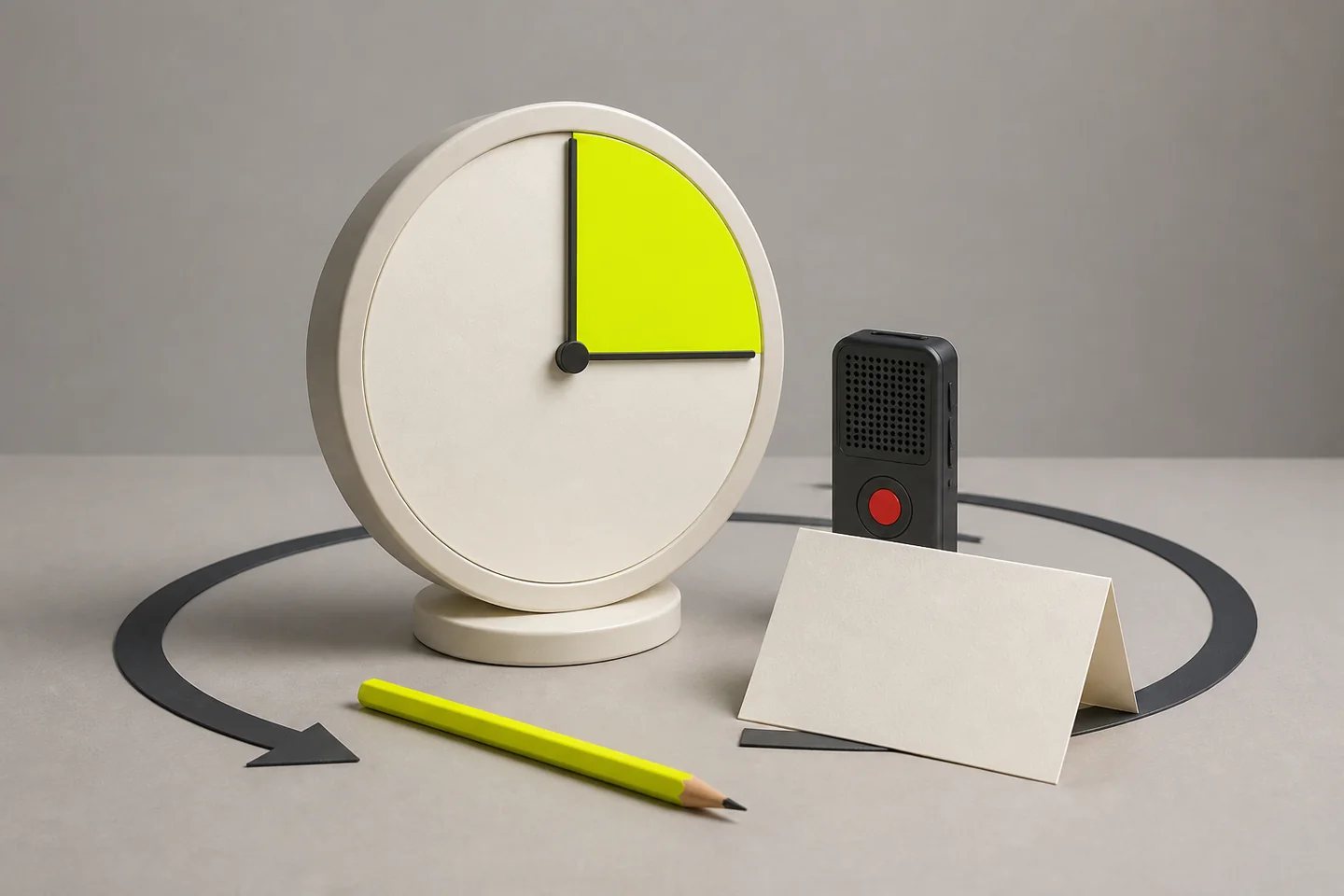
A useful practice session ends with something you have said, noticed and improved—not simply another video you have watched.
You do not need an empty calendar to begin speaking practice. You need a small task that still makes sense after work, between responsibilities or before your next class. The routine below takes fifteen minutes, but it is a suggested structure, not a scientifically guaranteed dose or a promise of fluency.
Use it to turn a little input into an answer of your own. If fifteen minutes is unrealistic today, use the shorter version later in this guide. Consistency should make practice easier to return to, not create another reason to feel behind.
- Choose one situation
- Speak and review
- Try one improvement
Give the session one real-life purpose
Before you set a timer, choose a situation: introducing yourself, asking for help, explaining a plan or giving a short update. Avoid a target as broad as 'improve all my English'. One situation helps you select vocabulary and judge whether the practice worked.
Keep the topic familiar. You can describe a meal you made, a journey you took or something you are learning. You should not need to research the subject before speaking about it. Put your phone on a quiet setting and open a private recording app if you want to review your answer.
Use this listen, speak, review routine
The British Council suggests self-talk and listening back to recordings as practical options for busy learners, while also recognising the value of conversations with people. The schedule below is our own way to organise that kind of practice. Adjust the timing to suit your level.
Choose a short, understandable example from a trusted learning resource. You are not trying to finish a whole lesson. Notice one expression you could use, then close the source. Most of this session is for producing your own answer and improving one part of it.
| Time | What to do | What to keep |
|---|---|---|
| Minutes 0–3 | Listen to a short example and identify one useful expression | One phrase you understand |
| Minutes 3–7 | Answer a familiar question aloud in your own words | A short first attempt |
| Minutes 7–10 | Listen back or reflect on the exchange | One unclear point |
| Minutes 10–13 | Try again, changing one detail | A clearer second attempt |
| Minutes 13–15 | Note your next practice task | One specific next step |
Further reading: British Council: Listening and speaking for busy learners
Change the answer instead of repeating a script
Suppose today's question is 'What would you like to learn next?' Your first answer might explain why you want better English for work. On the second attempt, add a specific situation such as asking a question in a meeting. On the third, imagine you are speaking to a new classmate rather than a manager.
This small change keeps you connected to the meaning. Reading the same polished paragraph five times may feel smooth, but it does not tell you whether you can respond when a person asks something different. Use notes if needed; gradually reduce them to a few key words.
Do not turn the session into a hunt for sophisticated synonyms. If a simple word expresses your meaning, keep it. The useful question is whether your listener would understand the point and know how to respond.
A prompt with room to grow
What is one skill you want to improve? Say what it is, explain where you would use it and describe one small action you can take this week.
Review for meaning before mistakes
Listen to your recording once as a listener, not as an examiner. Could you identify the main point? Was a detail missing? Did you leave enough space between ideas? Pick one thing to improve and make another attempt. You can address grammar or pronunciation, but do not try to repair everything at once.
Automatic transcripts can offer a clue about unclear words, but they are not a reliable final judge of pronunciation. Background noise, names and accents can affect what they recognise. When possible, ask a willing person whether they understood the message. Keep private or sensitive information out of any recording you upload to a service.
Use different situations across the week
A small rotation prevents practice from becoming the same introduction forever. The plan below moves from talking about yourself to handling another person's response. Swap the days, repeat a topic or leave a rest day. It is a menu of tasks, not a streak you must protect.
At least one session should involve a real exchange when you have a willing partner. Let them choose the follow-up question. If nobody is available, practise the solo version and arrange a conversation when you can. Do not treat that practical limitation as failure.
| Session | Speaking task |
|---|---|
| 1 | Introduce yourself to a new learning group |
| 2 | Explain a preference and give a reason |
| 3 | Describe a small problem and request help |
| 4 | Tell a short story about something that happened |
| 5 | Give an update about a task or learning goal |
| 6 | Answer a partner's unexpected follow-up |
| 7 | Repeat one earlier task and compare the message |
Have a minimum version for busy days
When time is tight, use three minutes: choose a prompt, speak for a minute and repeat one sentence more clearly. That is not identical to a full session, but it keeps the next attempt approachable. If you miss a day, return to the next useful task instead of doubling the workload as punishment.
Link practice to something stable in your day, such as finishing breakfast or preparing for class. Keep the prompt ready in advance. Review progress using the task itself: can you now explain your plan with less preparation, or ask a follow-up without writing it first?
Self-practice is convenient, but it cannot supply every part of a conversation. Guided classes add listening, turn-taking and questions you did not choose. Spoken English Zero to Pro includes a personal speaking portfolio and a practical improvement plan, so the work you do between classes can have a clear direction.
Set up tomorrow's practice in two minutes
- Choose one everyday question and save it where you will see it
- Pick a realistic fifteen-minute slot, or plan the three-minute version
- Record a first answer without writing a complete script
- Choose one improvement and make a second attempt
- Keep one note about what to practise in your next conversation
Give your daily practice a direction
Combine your own routine with guided conversation, listening and a personal speaking portfolio in Spoken English Zero to Pro.
Create Your AccountOur practical examples are learning exercises. References are linked beside the relevant sections. Course fees, schedules and access terms are maintained on the course pages. Tell us if something needs correcting.