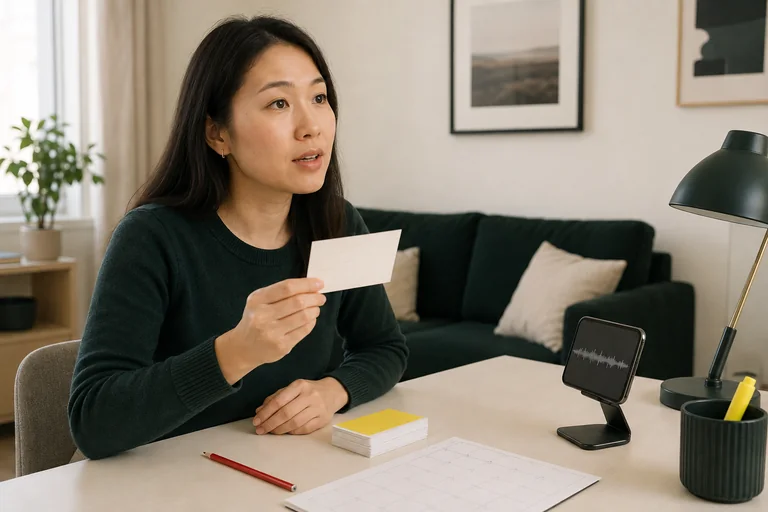
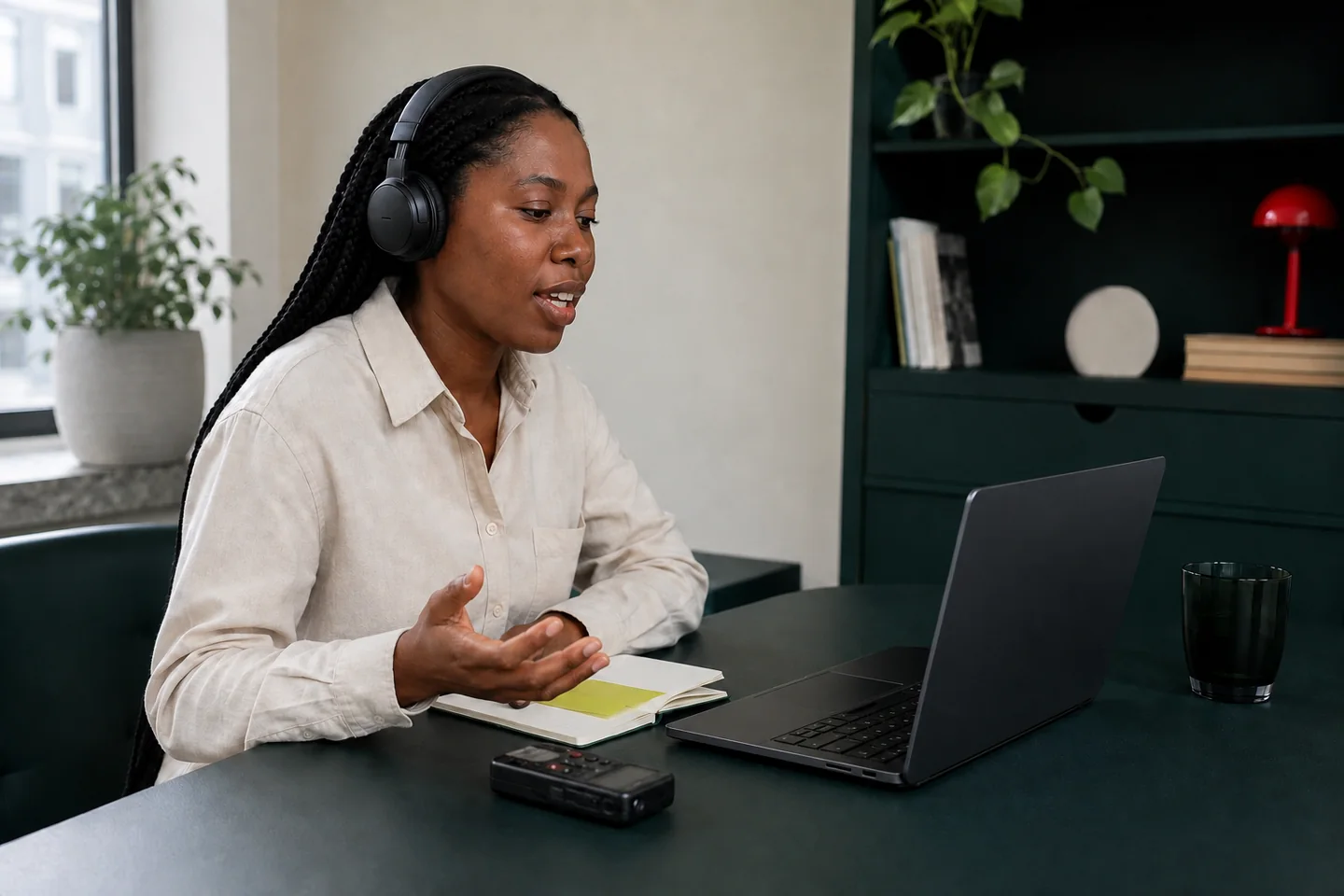
Shadowing can help you work on how English sounds, but copying a speaker is not the same as choosing your own words. Finish with an original response and judge clarity, not accent imitation.
You hear a clear English sentence and think, 'I know every word, but mine does not sound like that.' The difference may involve where the speaker pauses, which words carry emphasis or how they group an idea. Replaying the whole video is not always the most useful way to examine those details. A short, deliberate listening-and-speaking exercise can give you a narrower target.
Shadowing means speaking along with a recording, following a little behind the original speaker. It is more demanding than listening, pausing and repeating afterwards. This guide shows how to prepare for it, practise without chasing speed and connect imitation to something you want to say. It also explains why the evidence deserves a more careful reading than 'copy audio and become fluent'.
- Understand the clip
- Follow the voice
- Make a new response
Promising evidence is not a universal guarantee
Foote and McDonough's 2017 study followed 16 advanced English learners practising shadowing with mobile technology over eight weeks. Ratings improved for comprehensibility and fluency, but not accentedness. The study had no control group, and participants had other English exposure, so the improvements cannot confidently be attributed to shadowing alone.
The distinction matters: being easier to understand is not the same as sounding less accented. This small study is a reason to consider the exercise, not proof that it is the best method for every learner. Its results also do not establish a rapid route from beginner English to spontaneous, confident conversation.
Use shadowing as a focused experiment within a broader learning routine. Choose a feature to notice, practise it and see whether it becomes clearer in your own speech. If the task is too demanding, simpler listen-and-repeat work may be a better starting point. You do not need to force a difficult technique merely because it is popular online.
Further reading: Foote & McDonough (2017): mobile shadowing and pronunciation
Choose audio you can understand before you copy it
Look for a short recording with one clear speaker, little background noise and a reliable transcript. Use a legitimate learning resource or a recording you have permission to practise with. A ten-to-twenty-second excerpt is a manageable starting suggestion, not a scientifically optimal dose. Choose a message you can explain in your own words.
Do not begin with a rapid argument, a heavily edited comedy clip or a speech full of unfamiliar vocabulary. You would be trying to solve listening, meaning and production problems simultaneously. A simple explanation about plans, work or daily life gives you room to notice the sound rather than merely survive the clip.
Listen once for meaning. Then check unfamiliar words and decide what the speaker wants the listener to understand. If the transcript does not match the recording, choose another source. You want a dependable model, not an automatic caption error repeated until it feels familiar.
A sentence you can make meaningful
I can join on Thursday, but I need to leave at six. First check the meaning: the speaker is available on Thursday, with a time limit. Listen for how the speaker separates the availability from the condition. There is no need to imitate a personality or exaggerate an accent.
Prepare the sentence, then follow the voice
On a copy of the transcript, mark one or two useful pauses and the words that sound prominent. Your marks describe this speaker's delivery; they are not rigid rules for every version of the sentence. Listen again to check whether you actually hear the feature you marked. Focus on one detail at a time rather than trying to correct every sound.
If speaking while listening feels impossible, pause after a short phrase and repeat it. That is preparation, not simultaneous shadowing. When comfortable, replay the clip and follow just behind the voice. Keep the volume comfortable, breathe normally and stop if the practice strains your voice. Short attentive attempts are preferable to forcing a long, increasingly unclear performance.
Understand
Listen and explain what the speaker means.
Thursday is possible, but only until six.
Notice
Mark one pause or an important word you hear.
Notice the contrast after 'but'.
Shadow
Follow the recording a little behind the voice.
Practise the short clip without racing.
Speak freely
Close the transcript and answer a new question.
When could you join, and what is your time limit?
Pause-and-repeat is a helpful preparation option. The final original response is essential to this suggested routine, but is not shadowing itself.
Listen to your recording like a coach, not a critic
Record a short attempt if you are comfortable doing so. Compare one feature with the model: perhaps the pause before a condition or the clarity of the final time. Do not judge your whole identity, voice or English level from a few seconds of audio. Choose a specific change you can actually try on the next attempt.
A trusted listener can help answer a simpler question: 'What day and time did you hear?' If they understand the details correctly, that is useful evidence about the message. An automatic transcription can be an extra clue, but it can also mishear clear speech or guess from context. Do not treat its output as an authoritative pronunciation score.
You may not sound like the original speaker, and that alone is not a defect. Keep the focus on understandable speech and useful control over emphasis. If the same sound repeatedly causes misunderstanding, ask a teacher to help identify it. More whole-clip repetition may not resolve a specific sound you cannot yet distinguish.
The most important extra step: stop copying
After the clip, put away the transcript and change the situation. If the recording described availability, answer a question about your own plans. Keep a useful sentence pattern if you need it, but choose your own day, time and reason. Then ask a partner a follow-up question and listen to their answer.
This is where you discover what imitation has not yet solved. You may reproduce the original beautifully but hesitate when choosing a different verb. That does not make the session wasted. It tells you that your next task is retrieval or sentence-building, not another attempt at the original voice.
Broader speaking research also reminds us to look beyond an immediate performance. Kakitani and Kormos's 2024 distributed-practice study assessed fluency after delays, rather than judging only the last training attempt. That was not a shadowing study. For your own informal check, revisit the skill later with a different message instead of declaring success because today's clip feels easy.
Further reading: Kakitani & Kormos (2024): assessing distributed speaking practice
Use the method for the problem it can address
If you cannot understand the clip, choose easier listening material first. If you know the meaning but struggle to retrieve words in a conversation, add situation-based recall and partner tasks. If your speech is understandable but you avoid joining in, start with a small real exchange rather than trying to perfect every sound in private.
Keep a short note of the feature you practised and where you used it afterwards. For example: 'I paused before the condition when explaining my availability.' That is a more useful record than 'I shadowed for a long time'. Over time, rotate between listening, targeted sound work and original speaking so that copying remains a tool, not the only thing you practise.
Turn one audio sentence into your own answer
- Choose a short, clear recording with a reliable transcript and explain its meaning.
- Listen for one pause or prominent word; use pause-and-repeat first if needed.
- Follow just behind the voice for a few comfortable attempts and record one if you wish.
- Put the recording away and answer a new question using your own details.
- Ask a listener what they understood, then revisit the feature in a different message another day.
Build a voice that is clear and your own
Explore Spoken English Zero to Pro as a next step towards practical communication. Check the current course details and consider where you would most value guided learning.
Create Your AccountOur practical examples are learning exercises. References are linked beside the relevant sections. Course fees, schedules and access terms are maintained on the course pages. Tell us if something needs correcting.