Try to retrieve a useful phrase before looking at the answer, check it, then return to it later in a different situation. Remembering a phrase is a starting point for conversation, not the finish line.
You recognise 'Could you clarify that?' when you read it. Yet, in a meeting, you say nothing because the phrase does not arrive in time. Your notebook contains the answer, but your conversation cannot pause while you search every page. The missing practice may be bringing useful language to mind when a situation calls for it.
Spaced recall combines two decisions: attempt an answer before checking it, and revisit the material across separate sessions. This article turns those ideas into a small set of speaking prompts. The examples are our own practical routine, not a scientifically tested promise that flashcards alone produce fluent English.
- Recall from a situation
- Check and change
- Return and use it
What the evidence supports—and what it does not
Kim and Webb's 2022 meta-analysis covered 48 experiments with 3,411 participants. Spaced second-language practice generally benefited learning, with results affected by factors such as the learning target and test timing. This supports returning to material across sessions. It does not identify a single ideal calendar for everyone or show that phrase cards alone create conversational fluency.
Retrieval also needs sensible limits. Nakata's vocabulary study compared different numbers of within-session recall attempts. More attempts improved raw retention scores in some comparisons, but the picture changed when practice time was taken into account. The practical lesson is not to repeat one easy item endlessly. Make room for checking, later recall and actual use.
These studies concern particular learning tasks and measures. Our speaking-card routine applies the principles to everyday communication; that application should be judged by whether you can use the language when needed. A perfect card score is useful information, but it is not the same as answering another person spontaneously.
Further reading: Kim & Webb (2022): spaced second-language practice meta-analysis · Nakata (2017): repeated vocabulary retrieval and practice time
Put a situation on the front, not the whole answer
Choose a moment from your life: checking a time, asking someone to explain, politely declining or giving a reason for a delay. On the front of a card, describe the situation in simple words or draw a small cue. On the back, put one natural expression and a complete example. Use language you have checked with a reliable learning source or teacher.
The cue should make you produce a message. 'You did not hear the meeting time' is more useful for this exercise than seeing the entire sentence and reading it again. You may use your first language for the cue if that makes the task clearer. The aim is not to ban translation; it is to practise retrieving a usable English response.
Avoid collecting impressive expressions you rarely need. Start with a handful that match conversations you actually have. Keep the examples truthful and ordinary. A sentence about your real journey to work is easier to test in daily life than a dramatic sentence copied from a film.
| Situation cue | One possible spoken answer | Change the detail |
|---|---|---|
| You missed the time | Could you repeat the time, please? | Ask for the date or address instead. |
| You need a simpler explanation | Could you explain that another way? | Ask for an example of one specific point. |
| You cannot attend today | I cannot join today. Would tomorrow work? | Offer a different day or time. |
| You want to check your understanding | So we need to finish this by Friday, is that right? | Change the task and deadline. |
Say it before you turn the card over
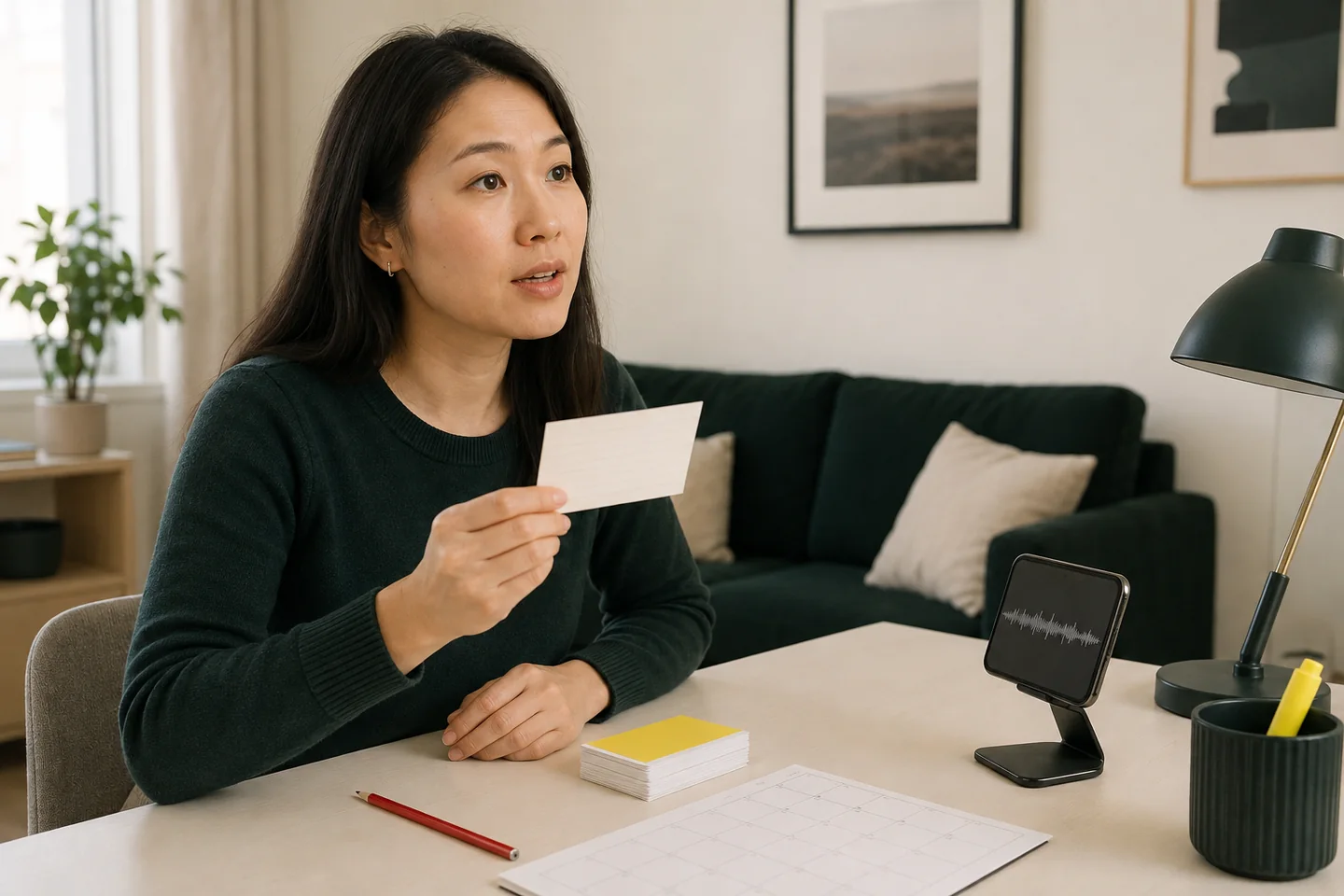
Read the cue and attempt an answer aloud. Give yourself a reasonable moment, but do not turn one difficult card into several minutes of frustrated guessing. If nothing comes, reveal the example, check its meaning and say it once with attention. Put it aside and return after another item. An unsuccessful attempt tells you what needs support; it is not a reason to punish yourself with more cards.
If your answer differs from the model, ask whether it is natural and carries the same meaning. There is rarely only one acceptable sentence. Check uncertain wording rather than marking every different answer wrong. Then change a detail so that the phrase becomes something you can adapt, not just a line you can reproduce.
Recall
See the situation and answer aloud before checking.
You missed a deadline: explain what happened.
Check
Compare meaning and wording with a reliable model.
Fix one unclear phrase; say the new version.
Change
Use the expression with a different detail.
Explain a late delivery instead of a late report.
Return
Try again in a later session without the answer.
Then use it in a short exchange with a partner.
This is an original practice routine informed by retrieval and spacing research, not a validated fixed-dose programme.
Use a flexible calendar, not a perfect algorithm
For a manageable starting experiment, try a phrase today, tomorrow, a few days later and again the following week. This is a suggested schedule, not a research-established optimum. If the phrase disappears completely, shorten the gap and simplify the cue. If it arrives easily in several different contexts, allow a longer gap and practise something else.
Keep one small record: needed help, recalled with effort or used comfortably. You do not need a complicated spreadsheet. An app can arrange reviews, but paper cards also work for organising this routine. What matters in your session is whether you actually attempt the answer, check it and make room for a later attempt.
A missed day does not require restarting from zero or doubling tomorrow's workload. Return to the items most relevant to your next conversation. A review system should make practice easier to resume, not create a growing debt that discourages you from speaking at all.
Remove the cue and let another person surprise you
After practising a request, ask a partner to respond in different ways. They might agree, offer another time or ask why you need the change. You now have to listen and choose the next sentence. That is the part a one-sided card cannot supply. Keep your first answer short enough to leave room for the other person.
For example, your cue may produce 'Would tomorrow work?' A partner can answer, 'Not tomorrow. Are you free on Thursday?' Your next task is no longer remembering the original phrase; it is checking your availability and answering the question. Practise accepting, declining and proposing an alternative rather than repeating the same opening.
Use a real low-stakes opportunity when one arises, without forcing a rehearsed phrase into an unsuitable situation. Afterwards, record whether the message worked and what response you found difficult. That response can become tomorrow's new cue. Your conversations should shape your practice collection, not the other way round.
Measure what becomes available when you speak
At the end of the week, put the cards away and answer three fresh situations. Can you ask for clarification, propose a change and explain a simple reason without reading? Note where you still need help. There is no need to time every syllable or compare your speed with somebody else's.
Keep phrases that solve recurring problems, revise ambiguous cues and retire items you no longer need to review so often. If pronunciation is the obstacle, add listening and targeted pronunciation practice. If you understand the prompt but cannot build an answer, get help with the sentence pattern. Spaced recall is one useful tool, not a diagnosis of every speaking difficulty.
Build a tiny speaking-card set today
- Choose three situations you expect to face this week, such as asking for help or changing a time.
- Write one cue and one checked example for each situation, keeping the answer out of sight.
- Attempt each answer aloud, check it and change one detail.
- Arrange a short later review, adjusting the interval to how much help you need.
- Try an unscripted exchange using one situation and save the difficult follow-up as a new cue.
Turn remembered phrases into everyday conversations
Explore Spoken English Zero to Pro if you want a next step beyond studying alone. Review the course information and decide how it fits your communication goals.
Create Your AccountOur practical examples are learning exercises. References are linked beside the relevant sections. Course fees, schedules and access terms are maintained on the course pages. Tell us if something needs correcting.